
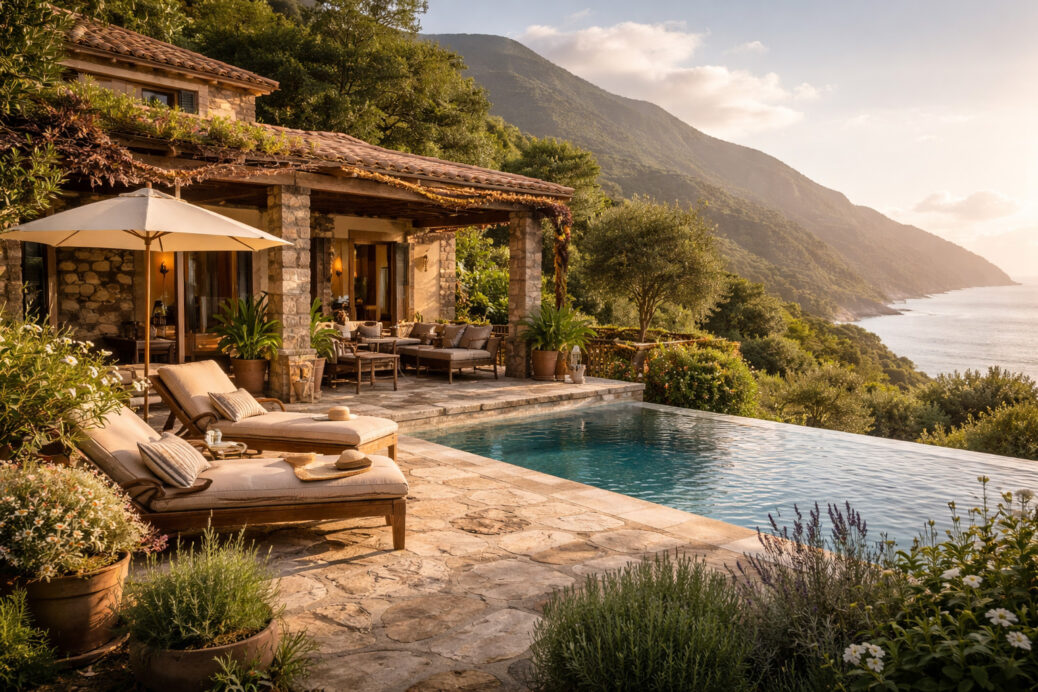
In Madeira, a terrace is never merely an outdoor space. At its best, it becomes the center of the stay.
The Island’s Most Overlooked Luxury
In many destinations, an outdoor terrace is treated as an amenity, listed somewhere after pool access and breakfast service. In Madeira, it often deserves to be the main event. The island’s geography — steep slopes, Atlantic horizons, changing light, and a climate that invites outdoor living for much of the year — gives terraces an unusual importance. They are where mornings begin, where afternoons soften, and where a stay often becomes most memorable.
At Madeira House Journal, we have come to see the sea-view terrace as one of the island’s defining pleasures. Not because every terrace is dramatic, but because the best ones alter the rhythm of a stay. A room may offer comfort, but a terrace offers perspective: weather, silence, movement on the water, and the shifting tone of the day as it moves from bright morning to late gold.
“A sea-view terrace changes how time feels. It asks less of you, and in return gives the day more shape.”
Morning Light, Evening Calm
The most beautiful terraces are not always the grandest ones. Some are narrow balconies with a simple table and two chairs. Others are wide stone platforms edged with planting, linen cushions, and a low wall warmed by the sun. What matters is less the square footage than the feeling they create. In Madeira, the morning light tends to arrive with real gentleness, and a well-positioned terrace makes breakfast feel less like routine and more like a private ceremony.
By evening, that same terrace may shift into something quieter and more reflective. A glass of wine, the sea changing color, the sound of distant movement below — these are small things, but they are often what remain after the trip is over. Madeira’s best stays understand this, and design accordingly. They leave room not just for furniture, but for pause.
Why Position Matters More Than Size
A terrace works only when it is placed with intelligence. On Madeira, orientation is everything. Too exposed, and the afternoon heat can flatten the experience. Too shaded, and the space never quite comes alive. The most successful terraces are those that negotiate the island’s elements carefully: enough shelter to remain comfortable, enough openness to preserve the feeling of being suspended between land and sea.
This is one reason some modest stays feel more luxurious than larger, more expensive ones. They understand exactly where to place a chair, how to frame a horizon, and when to let planting soften an edge. Good design on a terrace does not call attention to itself. It simply makes lingering feel inevitable.
The Memory of a Place
Travelers often speak about views as though they exist independently of the spaces from which they are seen. But that is rarely true. The memory of a landscape is tied to the terrace, balcony, or chair that made it feel personal. We do not just remember the Atlantic or the cliffs. We remember the coffee cup on the table, the softness of a cushion in early light, and the exact angle from which the horizon seemed to hold the entire day in place.
In Madeira, this is part of what makes a stay feel elegant rather than merely scenic. A great terrace does not only provide a view. It turns that view into atmosphere. And once it does, the stay becomes harder to leave behind.