
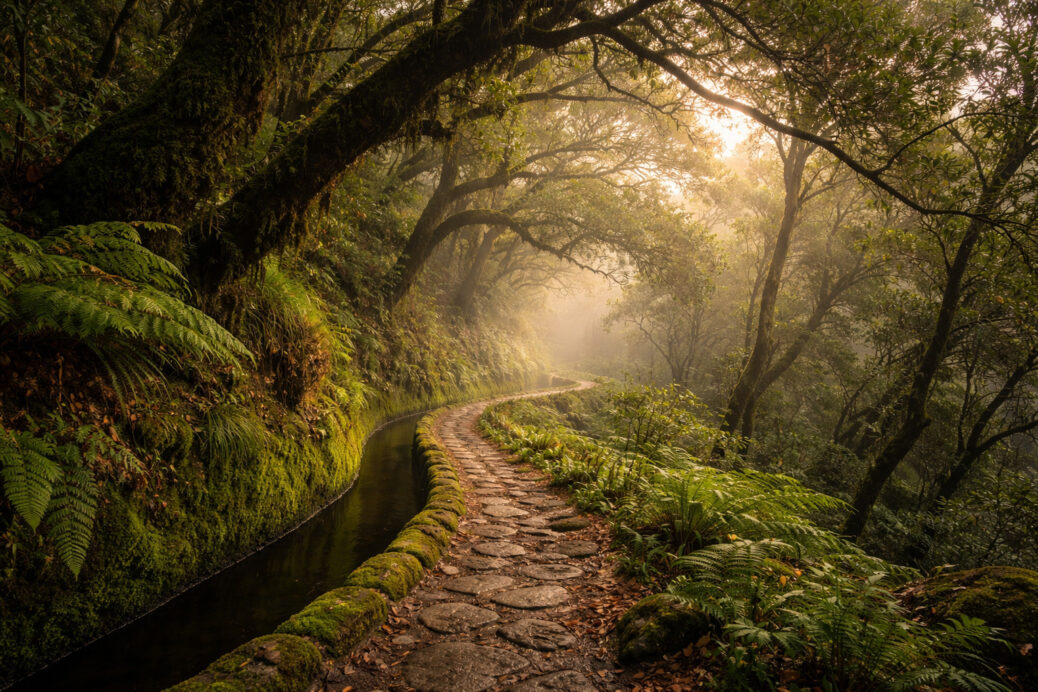
Some places impress immediately. Madeira does something more unusual: it settles over you gradually, like weather.
More Than Scenery
Madeira is often described through the obvious vocabulary of island beauty: cliffs, gardens, sea light, terraces, dramatic roads. All of this is true, but it still does not fully explain why the island feels so distinct. The real difference lies in atmosphere. There is a softness to Madeira’s air, a density to its greens, and a particular kind of hush in certain valleys and upland paths that makes the island feel older, deeper, and more inward than many coastal destinations.
Part of that sensation comes from the Laurisilva forest — the ancient laurel woodland that still shapes the ecological and emotional identity of the island. The UNESCO listing for the Laurisilva of Madeira is a useful reference point, not only because it establishes the forest’s significance, but because it hints at what travelers feel instinctively when they move through the island: this is not simply greenery, but an atmosphere with history inside it.
“Some landscapes are admired from a distance. Madeira’s are felt from within.”
Light, Moisture, and Silence
Travelers do not need to know the botanical history of the island to respond to it. They notice it in simpler ways: the coolness of a path even on a bright day, the drifting mist at higher elevations, the way leaves seem to hold and soften sound. Madeira’s atmosphere is textured. It does not arrive as a single dramatic scene, but as a sequence of subtle sensory impressions — moisture in the air, filtered light, distant water, flowers and foliage that feel unusually abundant.
This matters because it changes the rhythm of travel. Places with sharper, drier beauty often encourage motion: lookouts, photographs, quick movement from one highlight to the next. Madeira tends to encourage pause. Its richness is cumulative. You sit longer on a terrace, linger on a roadside viewpoint, or walk more slowly because the surrounding world does not feel like backdrop. It feels alive enough to ask for your attention.
How Landscape Becomes Mood
We often speak as though design creates atmosphere on its own, but the best stays are always in conversation with the landscape around them. In Madeira, that conversation is especially powerful. A villa terrace framed by dense planting feels different here than it would elsewhere. A hotel lounge with windows onto a green ravine carries a particular kind of calm. The island lends its own emotional register to the spaces built within it.
This may be why so many travelers find Madeira quietly restorative even when they are not consciously seeking rest. The island’s beauty is not only scenic. It is tonal. The Laurisilva, the cliffs, the mist, the gardens, and the sea all contribute to a larger mood — one that feels contemplative rather than performative, and generous rather than demanding.
The Memory That Remains
Long after a trip, what remains is rarely a single attraction. More often, it is an atmosphere difficult to summarize: a particular shade of green, a terrace after rain, a road bending through cloud, the way the sea looked from a garden wall just before dusk. Madeira leaves that kind of memory. Not only because it is beautiful, but because its beauty is held together by something older and more continuous than tourism itself.
That, perhaps, is what makes the island feel different. It is not simply that Madeira has scenery. It is that the landscape still seems to possess an interior life — and when a place has that, even a short stay can feel unusually lasting.