
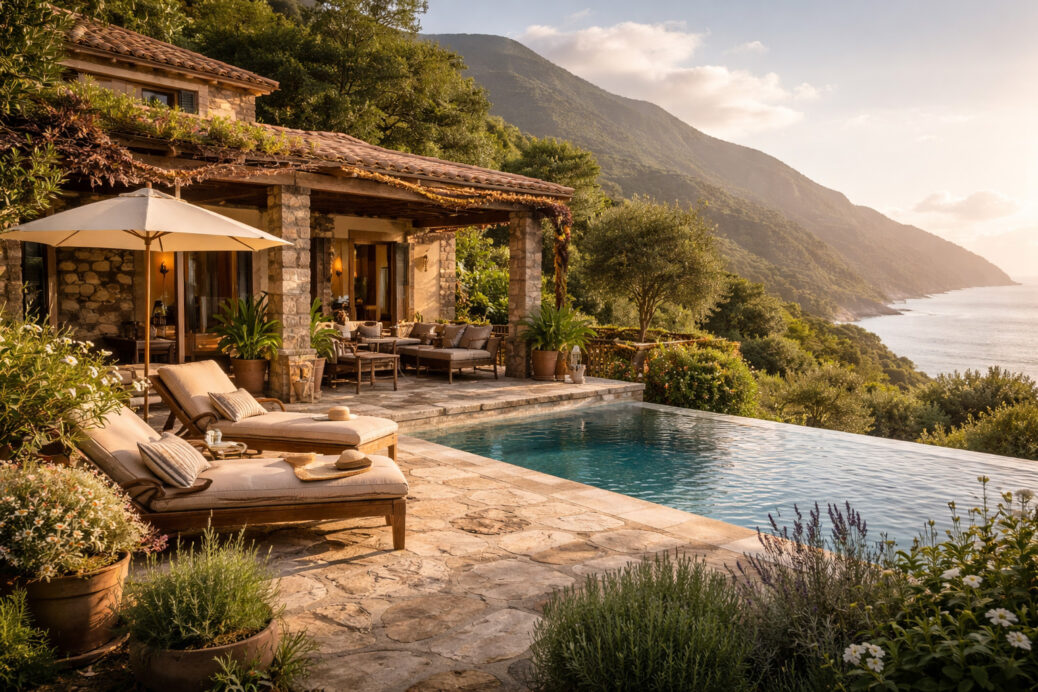
A beautiful villa should never feel dropped onto a landscape. It should feel as though it belongs to it.
More Than a View
The appeal of a villa is often reduced to a few familiar promises: privacy, a pool, generous space, and a beautiful outlook. But the villas that stay in the memory are rarely defined by amenities alone. What distinguishes them is the sense that the architecture, the materials, and even the rhythm of the rooms have been shaped by the land around them. The view matters, of course, but so does the way the house meets it.
At Madeira House Journal, we look for private stays that feel inseparable from their setting. A terrace should seem to emerge naturally from the hillside. Stone should carry some echo of the local earth. Windows should frame sea, garden, or sky in a way that feels considered rather than merely expansive. The best villas do not simply overlook a place. They belong to it.
“A great villa does not compete with the landscape. It edits it gently, then invites you to live inside the result.”
Architecture That Responds
The finest villas tend to respond rather than impose. On steep ground, they step with the slope instead of flattening it. In hotter climates, they rely on shade, airflow, and thick walls rather than decorative excess. In greener settings, they open toward gardens and terraces so that indoor and outdoor life flow naturally into one another. These decisions make a house feel calmer, and often more luxurious, because nothing seems forced.
This is one reason some villas feel immediately persuasive while others remain strangely anonymous. A property can be expensive, expansive, and immaculately styled, yet still feel disconnected from the world around it. By contrast, a simpler house can feel far richer if it understands where it is: the direction of the light, the pull of the wind, the contours of the site, and the emotional power of the surrounding landscape.
Materials, Texture, and Memory
Material choices are often what make this connection tangible. Timber that has been allowed to age, linen that softens the light, stone that holds the warmth of the day, shutters that move with the breeze — these details give a villa emotional credibility. They make the stay feel grounded instead of staged. Even when a property is highly refined, it should still retain some tactile relationship with the place it inhabits.
Travelers may not always articulate this consciously, but they feel it. They remember the cool floor under bare feet in the morning, the scent that rises from a garden after heat, the texture of a stone wall at dusk. These are not decorative flourishes. They are the physical language through which a villa becomes memorable.
Why It Matters More Now
In a market crowded with glossy private rentals, rootedness has become a more meaningful marker of quality than scale alone. Travelers are growing better at noticing when a property could exist anywhere, and when it could only exist exactly where it is. The latter always feels more valuable. It offers not just privacy, but a deeper sense of arrival.
That is why the best villas continue to feel rare. They do more than provide comfort and seclusion. They translate landscape into atmosphere, and atmosphere into memory. When a house is truly rooted in its setting, leaving it behind feels a little like leaving the place itself.